


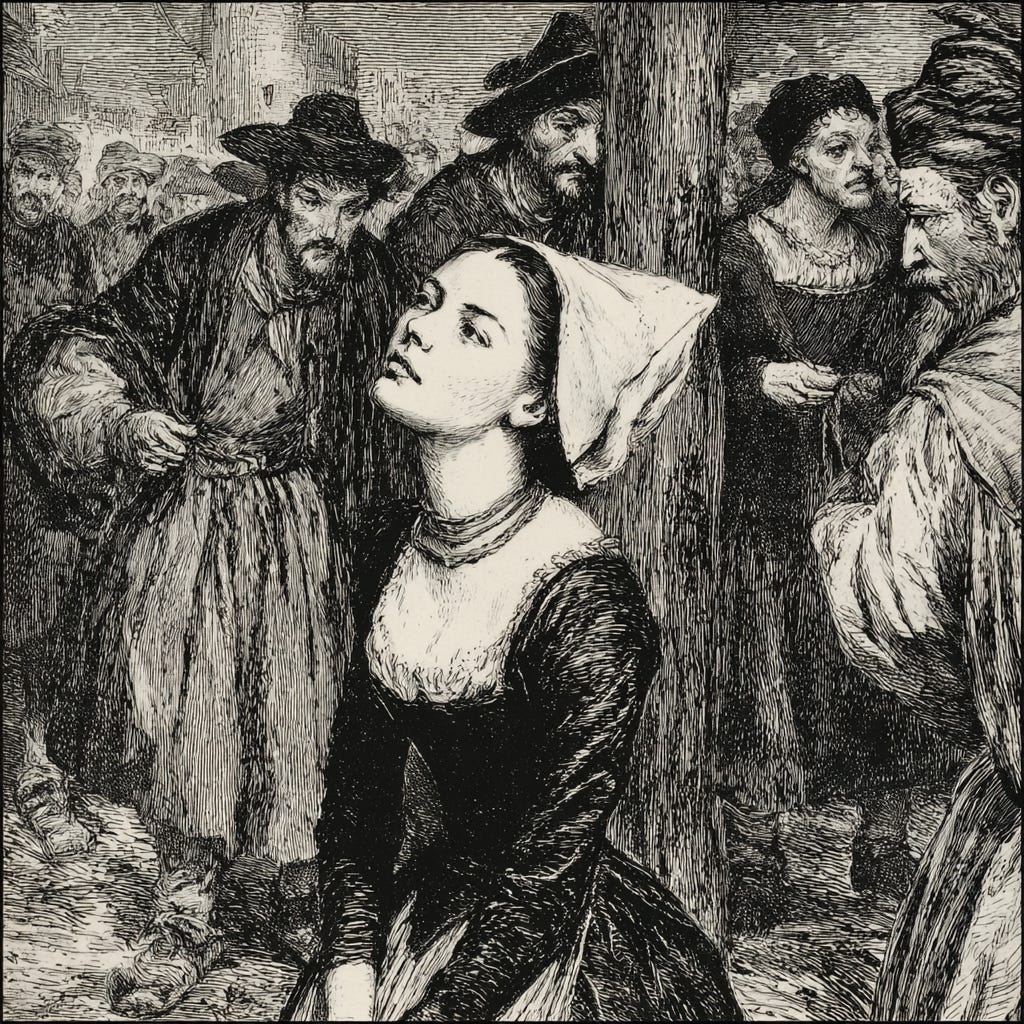
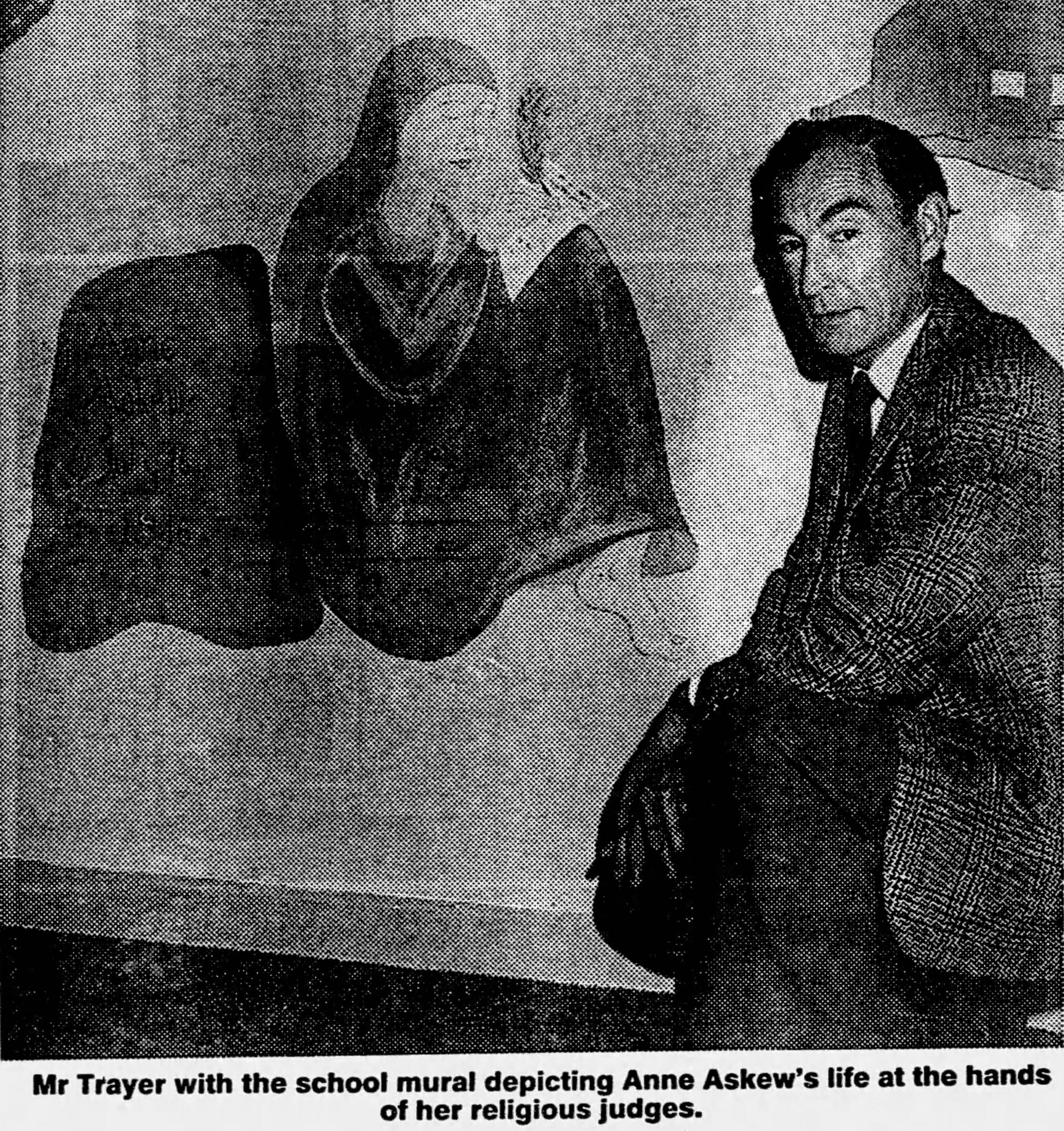
In July 1546, 25-year-old Anne Askew was carried to Smithfield, London, to face her death, unable to walk after being tortured on the rack inside the Tower of London. Her crime was not murder, treason, or conspiracy. It was her belief.
She refused to renounce her Protestant faith. She refused to betray the names of other believers. And she refused to let her accusers break her spirit. By the time the flames rose around her, Anne Askew was no longer just a prisoner condemned by the state.
She stood as one of the most unforgettable figures of the English Reformation — a young wife, mother, writer, preacher, prisoner, and martyr whose body was destroyed because her faith could not be shaken.
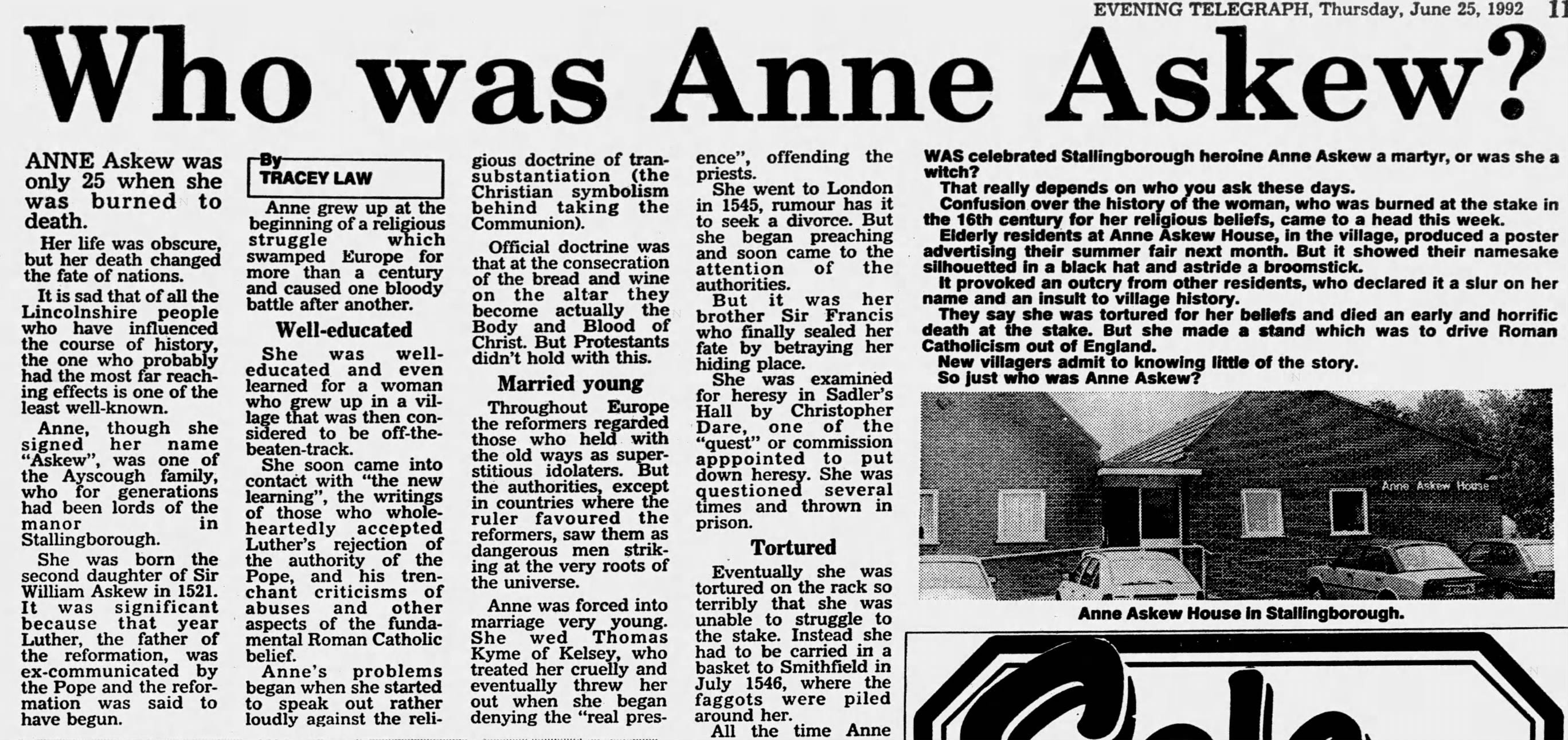
Background
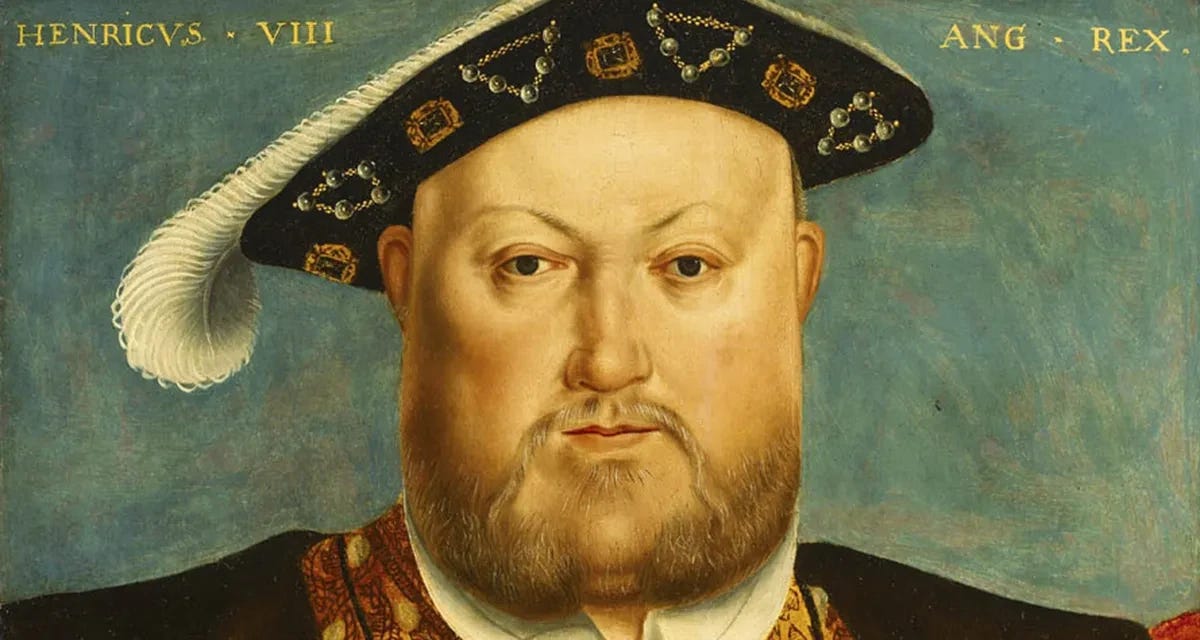
In the tense and dangerous final years of Henry VIII's reign, England was a country caught between old religion and new reform. The king had broken from Rome, but religious freedom had not truly arrived. Belief was still watched. Speech was still dangerous. The wrong interpretation of Scripture could lead a person from the church pew to the prison cell, and from the prison cell to the fire.
Henry VIII had created the Church of England after breaking from the Roman Catholic Church, but in doctrine he remained far more conservative than many reformers hoped. The Act of Six Articles, passed in 1539, enforced traditional Catholic teachings and made denial of transubstantiation a deadly offense. For Protestants who questioned the official teaching on the Eucharist, breaking this law could mean a death sentence.
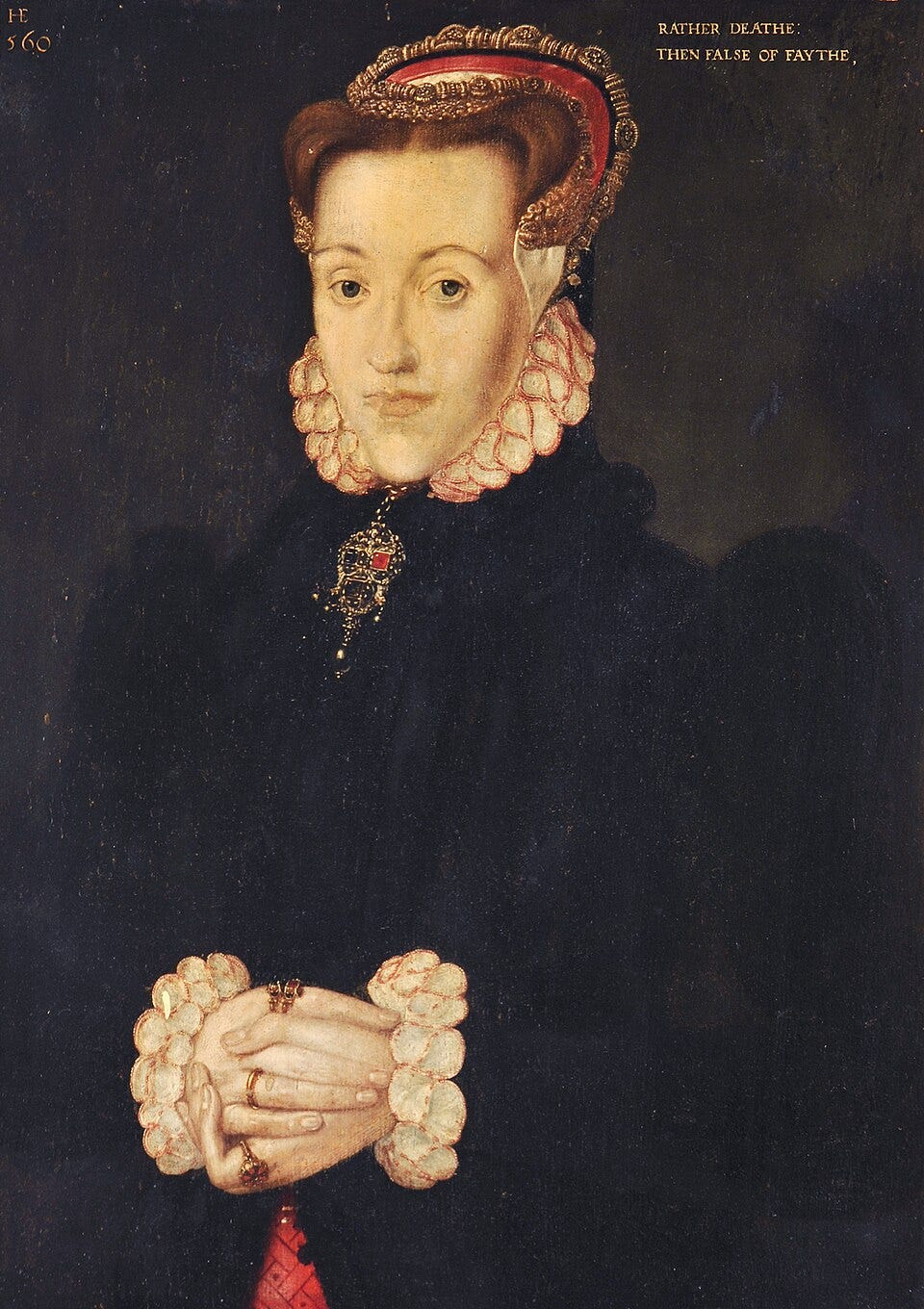
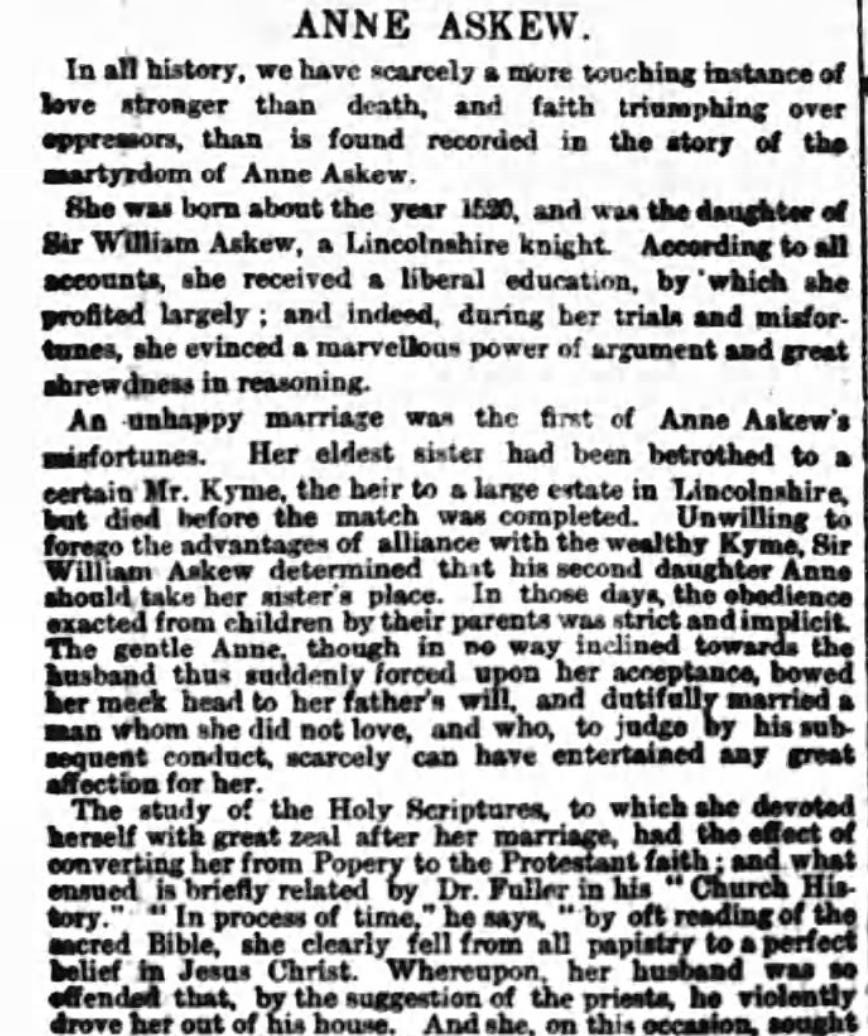
This is the world that Anne Askew was born into. Sometimes written as Anne Ayscough or Anne Ascue, she came from a wealthy Lincolnshire gentry family. She was the daughter of Sir William Askew — a respected landowner, courtier, high sheriff of Lincolnshire, and member of Parliament.
Anne was well read and highly educated, allowing her to argue convincingly and handle Scripture with a confidence that shocked the men who later questioned her. But in Tudor England, birth and education could only protect a woman so much.
A Gentry Daughter
Anne Askew was born around 1521 in Lincolnshire, England. She grew up in a world of family duty, arranged marriages, religious expectation, and strict obedience. Anne had four siblings, Francis, Edward, Martha, and Jane, with two additional half-brothers through her father's later marriage. Her family had wealth, land, and court connections, which meant Anne was expected to live according to the rules of her social class.
Those rules did not ask what a young woman wanted. Rather, they ensured that marriage would protect property, grow wealth and alliances, and satisfy family obligation.
Anne's older sister Martha had originally been arranged to marry Thomas Kyme of Friskney, a Lincolnshire gentleman. But Martha died before the marriage could take place. Rather than lose the match, Sir William Askew arranged for his younger daughter Anne to marry Kyme instead. Anne was still young, likely around 15, when she was pushed into a marriage she had not chosen.
Forced Marriage
Anne's marriage to Thomas Kyme was not a joyful union. Thomas was a Catholic, loyal to traditional religious teaching. Anne, however, became increasingly committed to Protestant reform. She read Scripture, questioned priests, and rejected doctrines she believed lacked a foundation within the Bible.
The couple had two children together. Their names are not preserved in the common historical record, but the fact that Anne bore Kyme two children is consistently recorded. For a woman of her status, motherhood should have established her firmly within the expectations of Tudor marriage: obedience to husband, loyalty to household, silence in matters of theology. But Anne would not remain silent.
Her Protestant beliefs caused trouble in Lincolnshire. She was accused of disrespecting local priests and of speaking too openly about religious matters. To her husband, this was not merely embarrassing. It was dangerous. Religion was not a private preference in Henry VIII's England. It could threaten one’s reputation, property, family and life itself.
Eventually, Thomas Kyme forced Anne from their home. Some accounts suggest she did not resist the separation, because the marriage had become unbearable. By early 1545, Anne had gone to London and was seeking a divorce or legal separation, first being denied by the bishop of Lincoln and then appealing to the Court of Chancery. This petition was apparently denied.
Networking in London
Anne now found herself a woman alone in London, educated, outspoken, and committed to reform, cut off from the home where her children remained.
By 1545, she had found lodgings in London near the Temple, at the very heart of the capital's legal world. London was crowded, tense, and politically charged. Reformers, conservatives, lawyers, clergy, spies, and royal officials all moved through the city's streets.
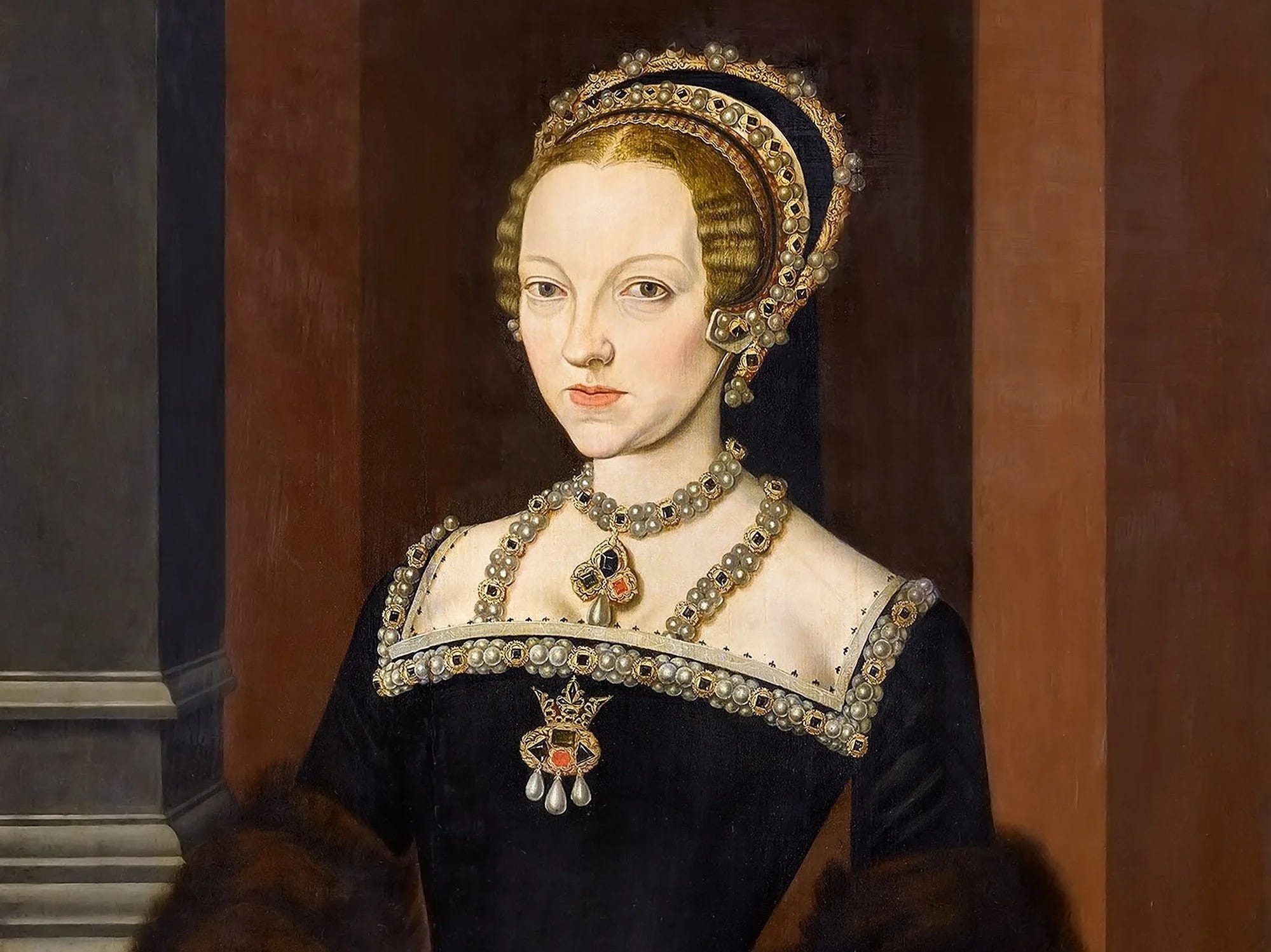
For Anne, London also offered possibility. It gave her access to legal channels, religious networks, and people sympathetic to Protestant reform. She became involved with reform-minded circles connected to Queen Katherine Parr, Henry VIII's sixth wife, who herself was known for religious learning and Protestant sympathies.
But that association also made Anne vulnerable to her enemies. If powerful religious conservatives could pressure Anne into naming others, they could damage the queen's reformist circle.
A Dangerous Faith
Anne Askew's central conflict with religious authority involved the Eucharist. The official church teaching defended transubstantiation: the belief that the bread and wine of Communion became the actual body and blood of Christ. Many Protestants rejected this, arguing for a more symbolic understanding.
These views placed her in mortal danger. Under the Six Articles, denial of the official teaching on the Eucharist could be treated as heresy and punished by burning. This was dangerous enough for a man. For a woman, it was almost unthinkable.
First Arrest
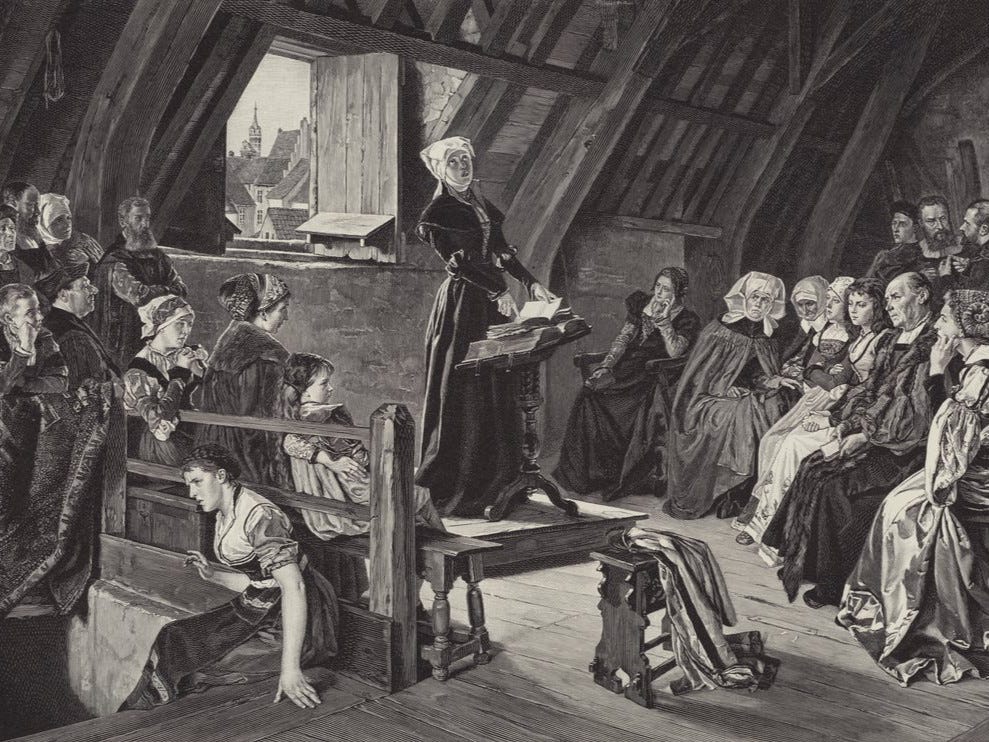
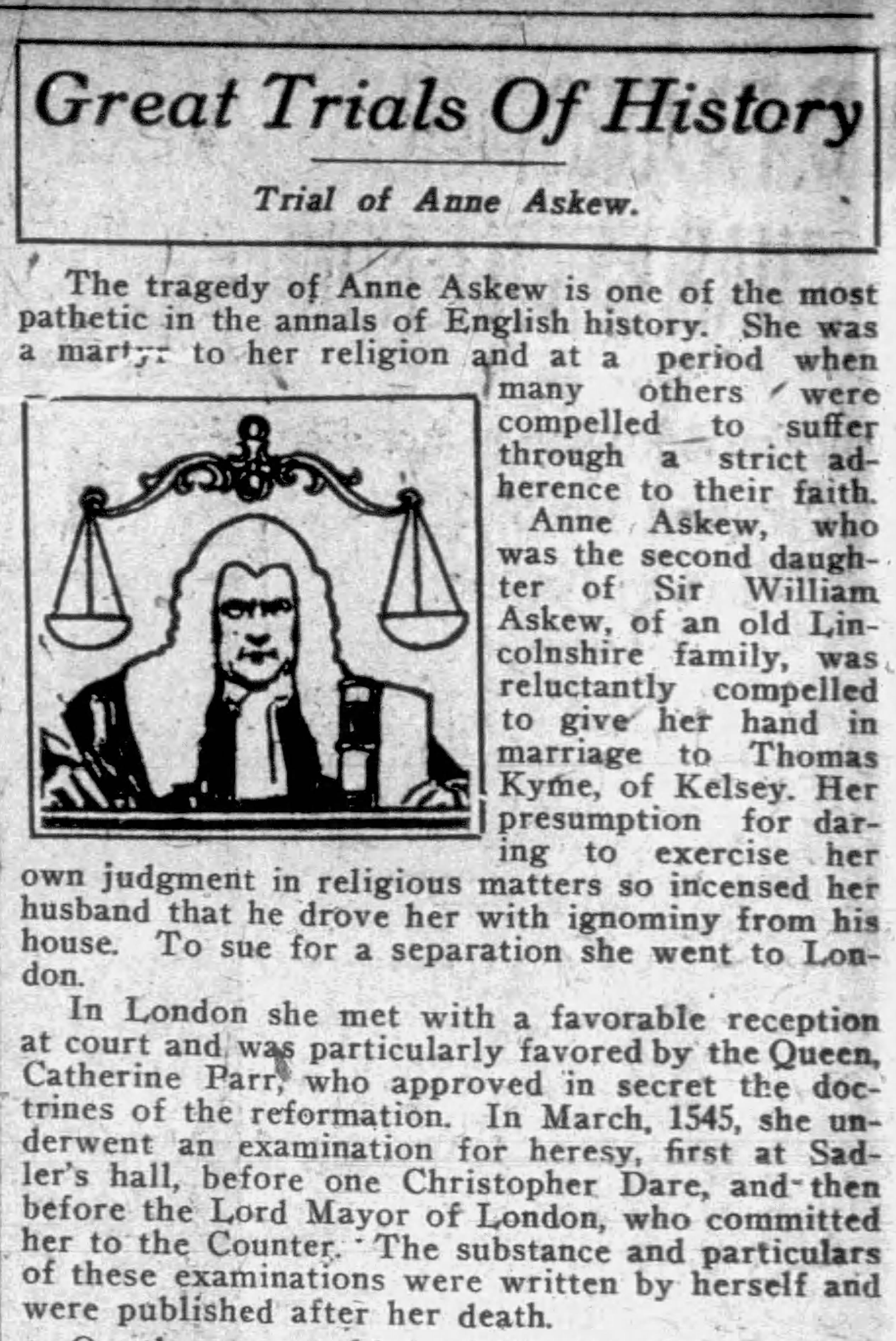
In March 1545, Anne Askew was arrested for heresy. She was “examined” under the Six Articles and questioned about her religious beliefs. The authorities wanted clarity, confession, and submission. Anne gave them none of those things.
She was questioned by officials, including those connected to the Bishop of London, Edmund Bonner. She was imprisoned for days, isolated from friends, and pushed to explain her views. Yet Anne's answers were careful. She did not fold under pressure. Nor did she hand her enemies the simple confession they wanted.
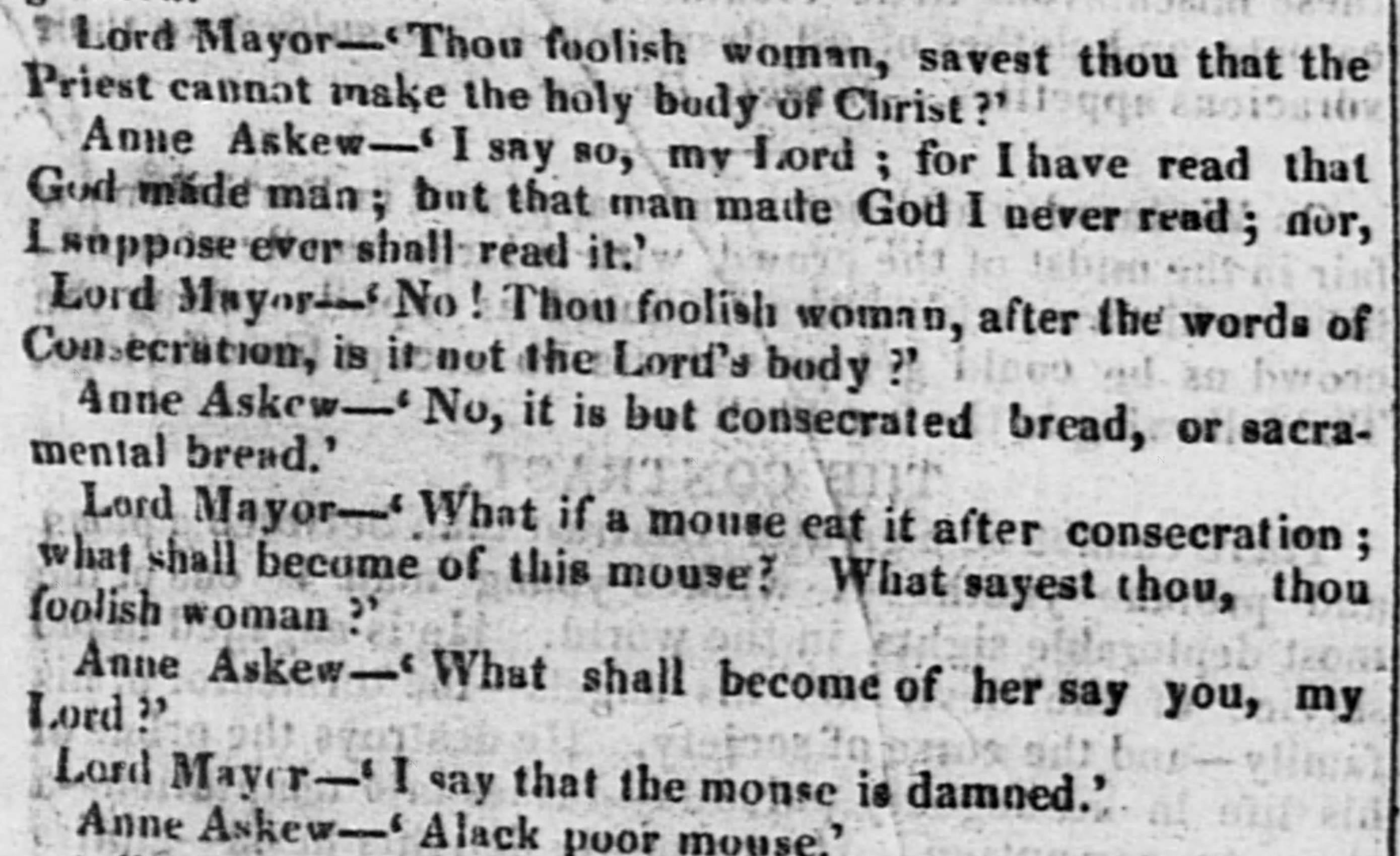
She was not easily intimidated. During questioning, she answered carefully, often with Scripture, refusing to be trapped by men who sought to use her words to condemn her.
Her confidence infuriated those who examined her. Aside from being accused of holding forbidden beliefs, she was seen as stepping outside the role society had assigned to her. She was a woman speaking theology, an area traditionally reserved for men.
Second Arrest
Anne was arrested again the following year in 1546. By then, the political climate had grown even more dangerous. Henry VIII was aging and unwell. The court was divided between religious conservatives and reformers. Queen Katherine Parr's enemies were watching closely, looking for an opportunity to strike at those around her.
Anne's arrest now carried a larger purpose. The authorities wanted names. They wanted to know who supported her. They wanted to know which noblewomen shared her beliefs. They wanted a window into the queen's inner circle.
Anne refused to give them what they wanted. She would not betray the others. She would not provide a list of friends, sympathizers, or suspected reformers. Her silence protected people who may have had far more power than she did and far more to lose if named.
However, her defiance ultimately sealed her fate.
Interrogation and Torture
Anne's interrogators consisted of some of the most powerful men in England, including Thomas Wriothesley, the Lord Chancellor; Sir Richard Rich, a ruthless legal and political figure whose name appears in more than one Tudor tragedy; and Stephen Gardiner, Bishop of Winchester, who was also part of the conservative religious force pressing against reform.
Rather than dealing with Anne as an individual, they sought to force open a network. The target was not merely Anne Askew; it was the entire Protestant influence around Queen Katherine Parr. Some believed that if Anne could be made to name women connected to the queen, Katherine herself might be placed in danger. Anne knew what they wanted. And she refused to give it to them.
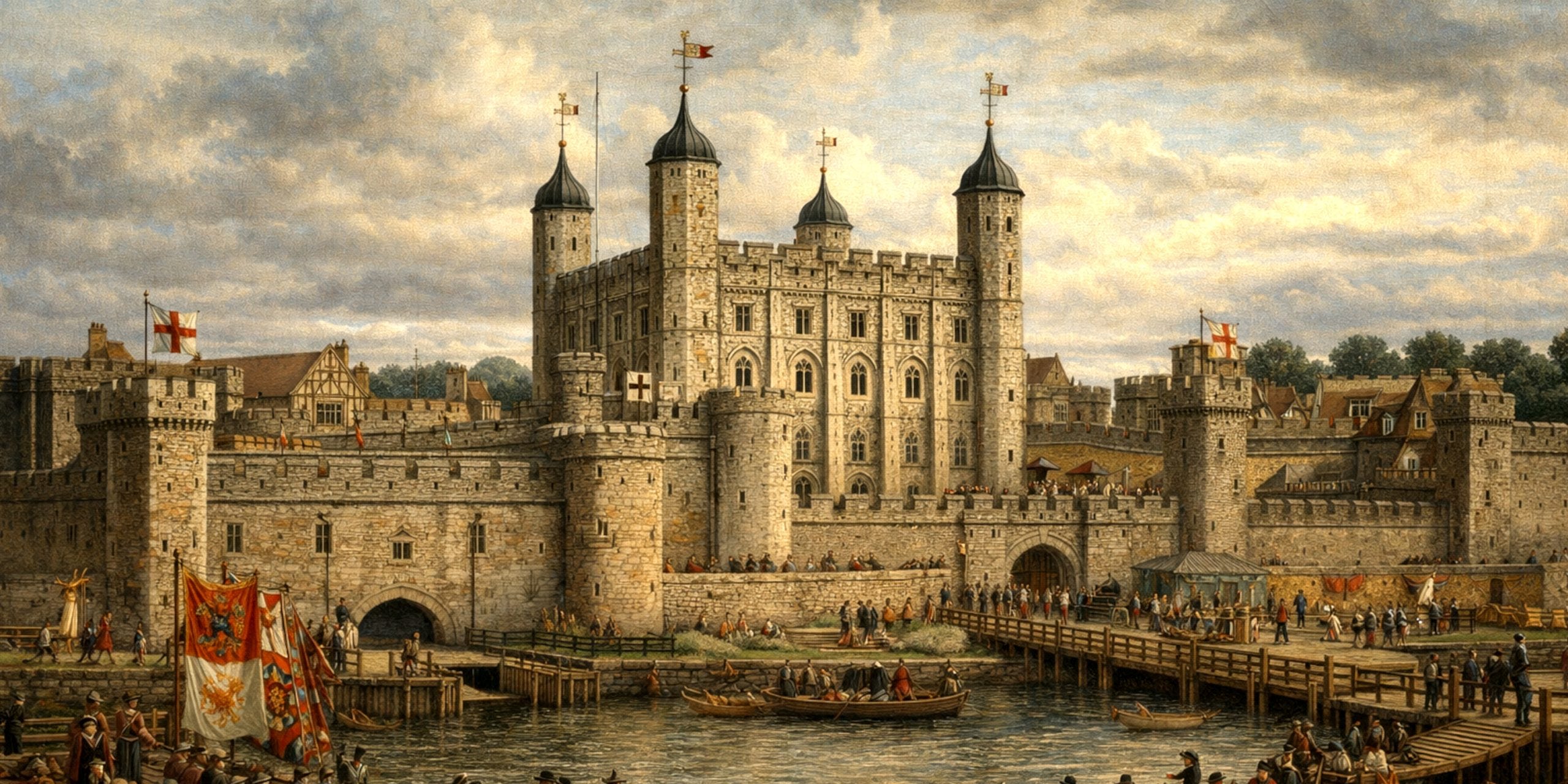
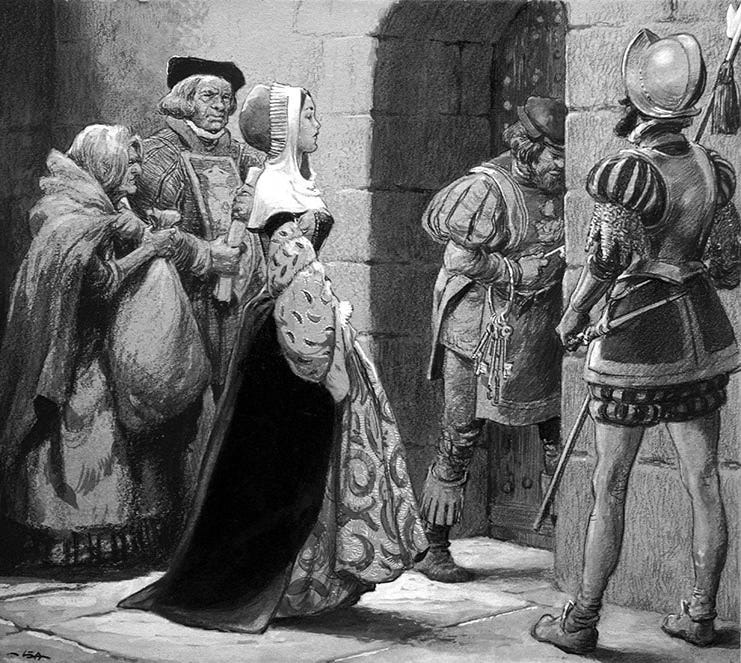
Anne was sent to the Tower of London, a place that by then had already solidified its fearsome reputation. By the Tudor period, the Tower had become one of the most terrifying symbols of royal power in England. It held nobles, traitors, religious prisoners, and political enemies. Some were treated with relative comfort... others were not as fortunate.
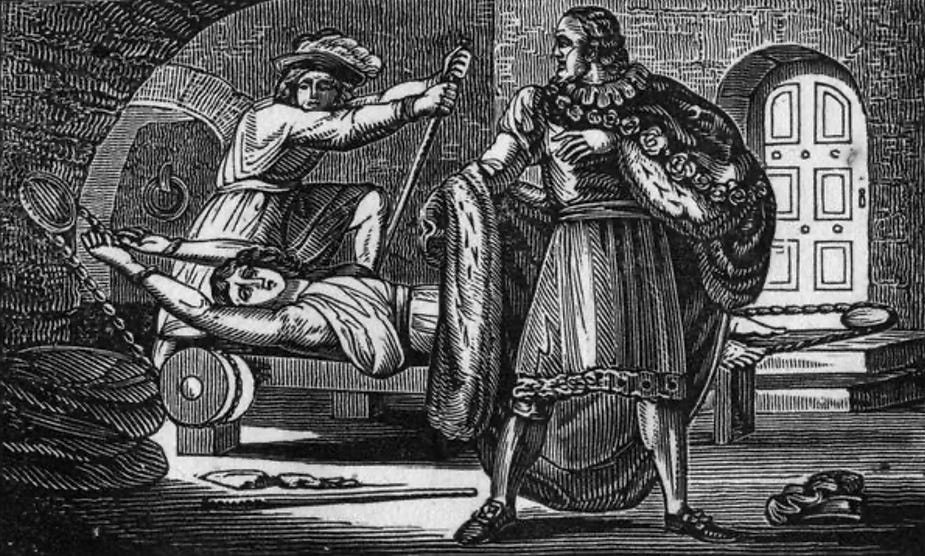
Anne was questioned again and again about her faith and about the people who supported her. Still, she refused to name names. Torture at the Tower was not always used, but when it was, it served a specific purpose: to turn silence into confession. One of the most terrifying of all the instruments of torture was a horrifying device known as the rack.
The device was a rectangular wooden frame raised slightly off the ground, in which the victims’ wrists and ankles were chained as their body was gradually stretched, causing excruciating pain as their limbs were dislocated and eventually separated. Anne Askew was taken to it because all prior words and questions had failed.
Anne was tortured on the rack inside the Tower of London. Her interrogators wanted her to implicate others, especially women believed to be connected to Queen Katherine Parr's reformist circle. Despite her agony, Anne refused.
She was stretched until her body could no longer bear it. According to later accounts, the Lieutenant of the Tower refused to continue the torture — so Thomas Wriothesley and Sir Richard Rich personally took over the rack themselves. They wanted names. Anne gave them none.
The injuries were devastating. Her shoulders and hips had been pulled from their sockets, and her elbows and knees had been dislocated. Her injuries left her unable to walk. Her body had been broken, but her silence remained intact.
Anne Askew had become something far more dangerous to her enemies than a prisoner. She became a witness against them. Her suffering exposed the cruelty of a system that claimed to defend truth and godliness while using pain to manufacture obedience
Execution at Smithfield
Anne Askew was condemned to death in June 1546. By then, the outcome was almost certain. She had been questioned, threatened, imprisoned, tortured, and still had not recanted. To the authorities, mercy was available only through submission, and Anne refused to submit.
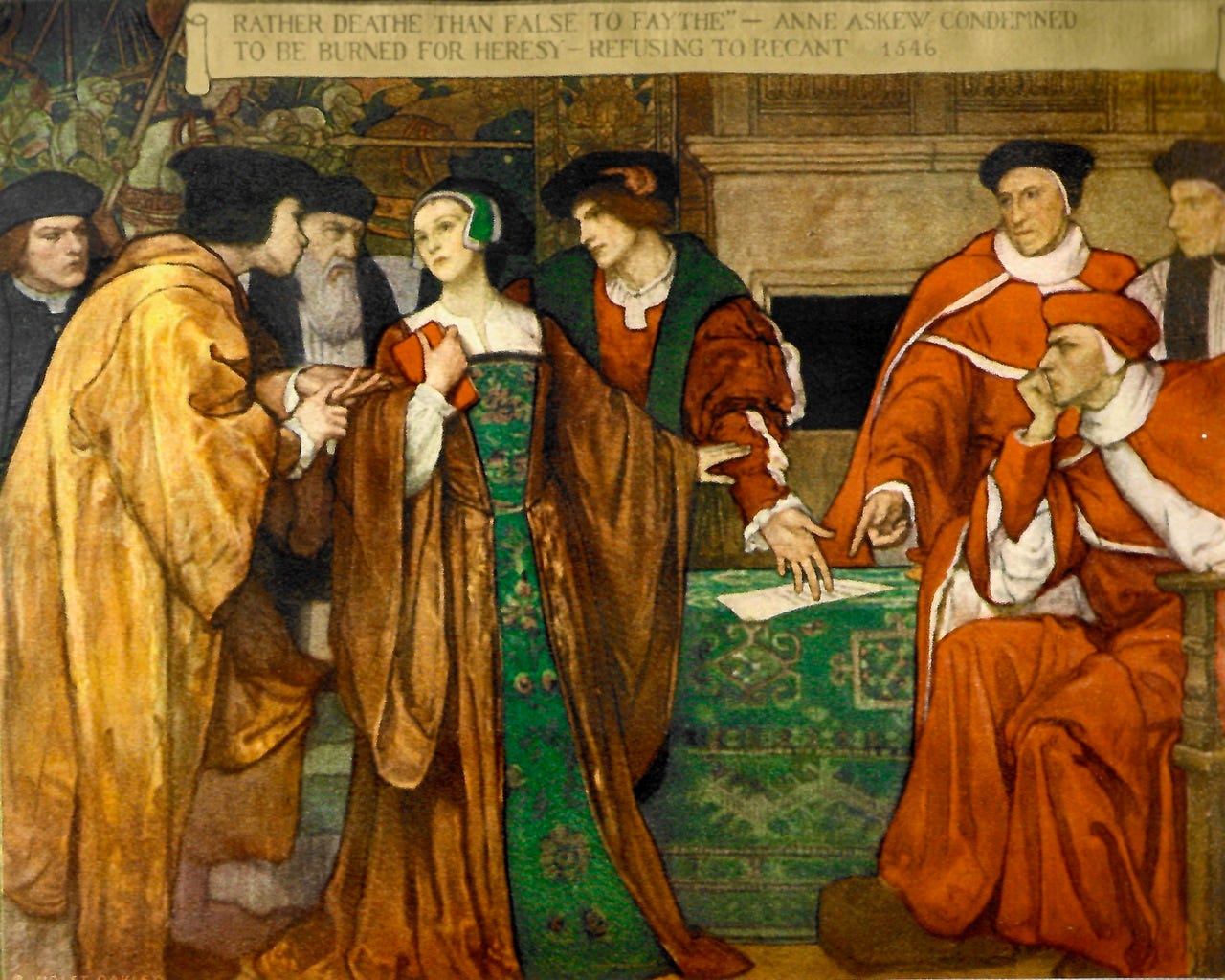
The sentence was death by burning. This was not simply an execution. It was spectacle. Burning heretics was meant to send a message to the living. The fire was public, visible, and symbolic. It warned others that private belief could become public punishment.
Anne was offered chances to recant. She could have saved her life by denying what she believed. She could have spoken the words her judges wanted to hear. But Anne had already made her decision.
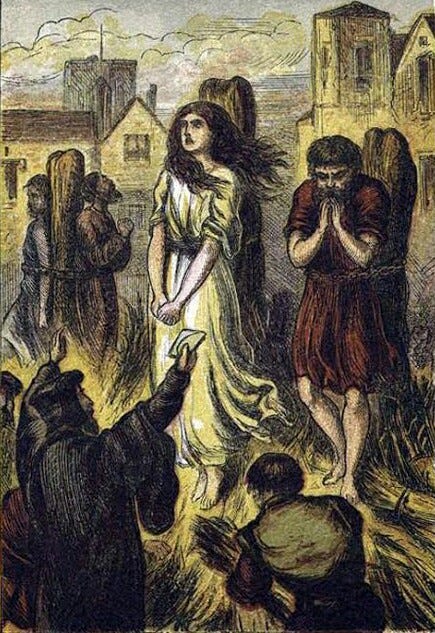
On July 16, 1546, Anne Askew was brought to Smithfield, London. She was only 25 years old. Because of the torture she had endured, she could not walk to the stake. Her body was so badly damaged that she had to be carried in a chair. She was executed with three other Protestants: John Lascelles, John Adams, and Nicholas Belenian.
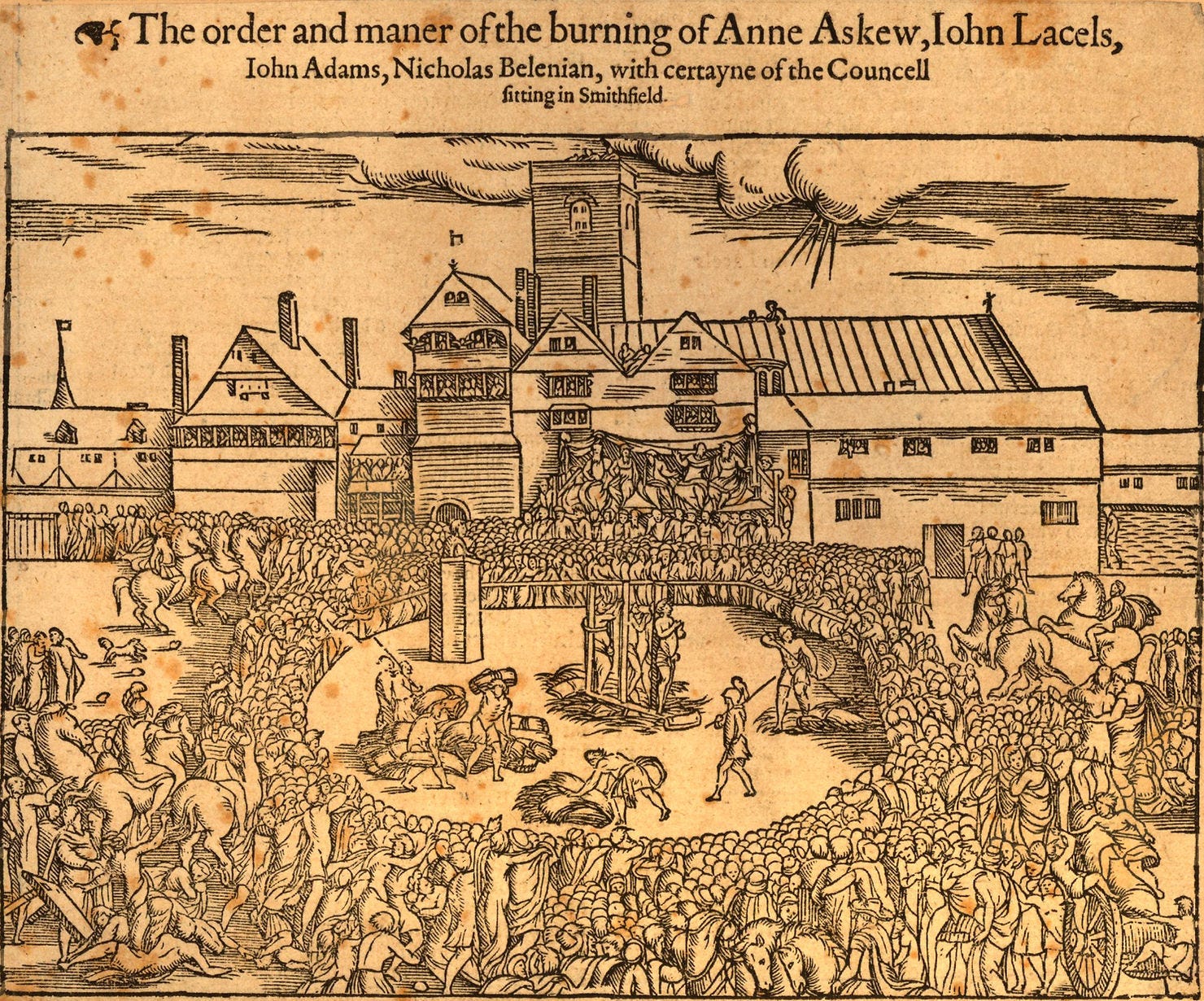
A crowd gathered, as they often did for public executions. Officials watched. Clergy preached. The condemned were offered one final chance to repent. Nicholas Shaxton, a former reformer who had recanted, preached at the execution. His presence made the scene even more bitter. He had once opposed the very laws that now helped send Anne to the fire. Now he stood there urging submission.
Anne remained firm. The image is almost impossible to look away from: a young woman, broken by the rack, carried to the place of execution because her legs could no longer bear her weight, then bound in place for the flames — not because she had killed, betrayed, or plotted against the crown, but because the state had decided her beliefs made her dangerous. At Smithfield, Anne Askew was burned to death.
Writings and Legacy
Anne's death did not erase her voice. Before her execution, she recorded accounts of her interrogations. These writings were later published as The First Examinacyon of Anne Askewe in 1546 and The Lattre Examinacyon of Anne Askewe in 1547. Together, they became known as The Examinations of Anne Askew.
These writings are uniquely valuable because they preserve the voice of a Tudor woman defending herself under religious and legal pressure. During her examinations, Anne showed how carefully she could answer men who were trying to trap her.
When Doctor Standish asked her to explain her interpretation from a text of Saint Paul, Anne avoided the trap by saying that, as a woman, it was not her place to interpret Scripture in front of so many learned men. It was a clever answer, using the very restrictions placed on women as a shield against her accusers.
At another point, when one interrogator asked why she spoke so little, Anne replied that God had given her the gift of knowledge, but not many words, adding that "a woman of few words is a gift of God." Her answers were calm, precise, and controlled. She gave them enough to show her intelligence, but not enough to give them the confession they wanted.
She was not simply a passive victim walking silently toward death. She argued. She resisted. She understood the danger around her and still refused to surrender her conscience. Her writings were later used by Protestant reformers, including John Bale and John Foxe, who presented her as a martyr of the Reformation. They helped turn Anne Askew from an executed heretic in the eyes of the state into a symbol of religious courage.
Anne Askew's savage torture and execution exposed more than the cruelty of Tudor justice. It exposed how deeply powerful men feared an educated woman who could read Scripture, question authority, and speak in her own voice. Anne challenged Catholic doctrine, but she also challenged something wider: a social order that expected women to remain silent in matters of faith.
Sources:
EBSCO Research Starters — Anne Askew — https://www.ebsco.com/research-starters/history/anne-askew
The Examinations of Anne Askew — Univ. of Virginia / Univ. of Amsterdam Digital Edition — https://anne-askew.humanities.uva.nl/index.htm
Context — The Examinations of Anne Askew — https://anne-askew.humanities.uva.nl/resources/context/index.htm
Historic Royal Palaces — Torture at the Tower Exhibition — https://www.hrp.org.uk/tower-of-london/whats-on/torture-at-the-tower-exhibition/
Encyclopedia.com — Askew, Anne (c. 1521–1546) — https://www.encyclopedia.com/women/encyclopedias-almanacs-transcripts-and-maps/askew-anne-c-1521-1546
Rylands Blog — Anne Askew: Author, Martyr and proto-Feminist — https://rylandscollections.com/2018/03/06/anne-askew-author-martyr-and-proto-feminist/
The Anne Boleyn Files — 16 July 1546: The Burnings of Anne Askew, John Lascelles, John Adams and Nicholas Belenian — https://www.theanneboleynfiles.com/16-july-1546-the-burnings-of-anne-askew-john-lascelles-john-adams-and-nicholas-belenian/
The detail that undoes me is that she had to be CARRIED to Smithfield — the rack had done its work and she still wouldn't recant or name names. And then there's the other half of the story: she wrote. The Examinations mean we hear her voice directly, not filtered through her executioners. A 25-year-old Tudor woman out-arguing the most powerful men in England with Scripture, then answering "a woman of few words is a gift of God." Extraordinary.